
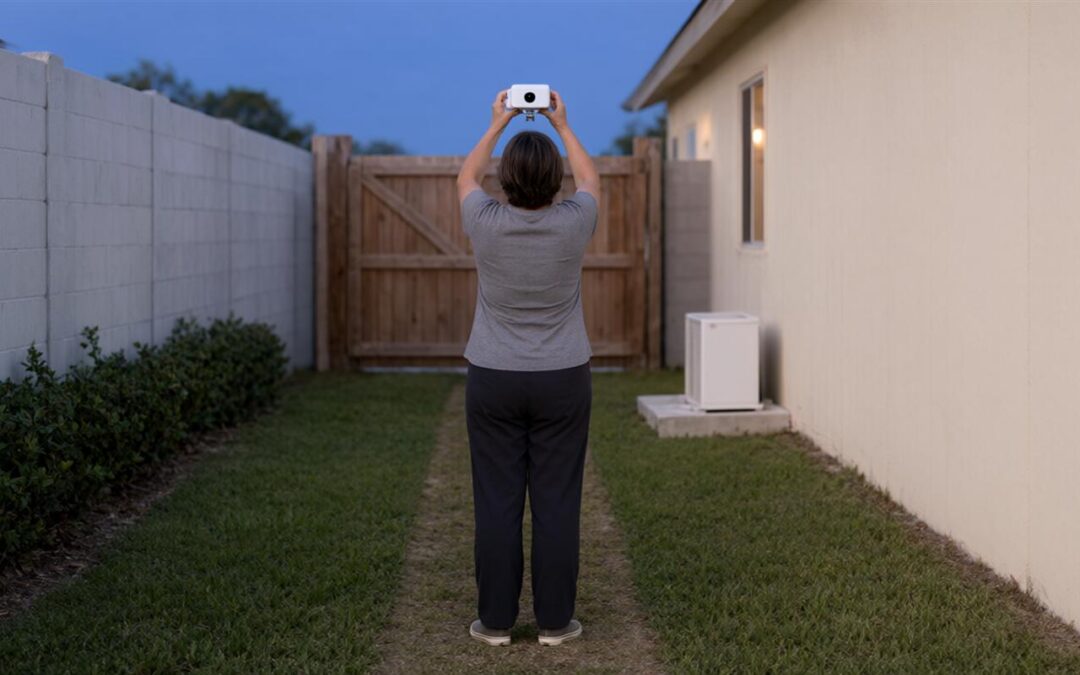
Most camera problems in a house are not equipment problems. A camera can be installed, running and recording, and still miss the one thing a homeowner wanted to see, because the lens was pointed at the wrong patch of wall. Good home security camera placement is mostly a matter of sightlines: where a person actually approaches, where the light falls, and what the camera can see without a hedge, a screen or a reflection in the way.
This article is written for the homeowner deciding where cameras go, not for a business laying out a storefront. It walks through the entrances, the windows and sliding doors, the garage and driveway, and the spots that tend to go uncovered, then explains how to test a position before anyone drills a hole.
Home Security Camera Placement at the Entrances
The front door gets the first camera in most homes, and it is usually the right starting point. What matters is the angle. A camera mounted directly above the door tends to record the top of a head and a slice of threshold, while a camera set back and slightly to one side takes in the walkway, the steps and the face of whoever is standing there. Height matters for a simpler reason: high enough to be out of easy reach, low enough that the view is not all roofline.
The front door is rarely the only way in. Side doors, service doors, a door off the laundry room and the one the household actually uses every day all deserve a look. In a house, that list changes the layout. A storefront or office usually has one public entrance to cover, which is part of why camera placement for offices and storefronts follows different rules: a house has several doors, a side yard and often a screened lanai, and each one changes what a single camera can see.
Two cameras at one entrance are sometimes worth it, sometimes not. A wide view of the drive and a tighter view of the door answer different questions. What should decide it is whether the approach is covered, not how many lenses are on the wall.
Windows, Sliding Doors, and the Glare Problem
Pointing a camera out through glass looks like an easy answer and often is not. At night, interior light turns the window into a mirror, and the recording shows the kitchen rather than the yard. The effect is strongest with a bright room behind the camera and a dark garden in front, which describes most evenings.
Sliding glass doors and screened lanais make this worse in Tampa Bay homes, because the glass is large and the screen adds a soft haze that flattens detail. Backlight from a porch light or a streetlight can wash out a face even when the camera does see outside. A camera mounted outside the glass, under an eave and out of direct weather, usually gives a cleaner image than one aimed through it. If inside is the only option, the view is worth testing at several hours of the day before it is trusted.
Curtains and blinds cut the glare and also cut the view, so the trade is real. A camera that only sees when the blinds are open is not covering much.
The Garage, the Driveway, and the Side Gate
The garage door is the largest opening on most houses, and the driveway is where a vehicle first appears. A camera that frames the approach rather than the door panel itself tends to be more useful: it shows who arrived, what they walked toward, and how long a car stayed. The camera does not need to sit directly over the garage to do that.
The side of the house is where coverage thins out. A gate between the house and the fence line, a narrow strip beside an air conditioning pad, a path to the backyard: these are places a homeowner walks past without noticing and a camera rarely watches. One camera covering the gate and the strip beside it closes a gap that three cameras at the front may not.
Angle matters in one more way here. A camera pointed at the street takes in a lot, including a neighbor’s driveway, front room and comings and goings. Keeping the field of view on the property line is both more considerate and more useful, since the footage a homeowner is likely to need is closer to the house.
Common Blind Spots in Clearwater Homes
Walk the property at dusk and the gaps become obvious. Even a careful home security camera placement plan tends to leave a few, because the positions were chosen from a ladder rather than from the ground.
- Side yard gates: usually outside the frame of cameras aimed at the front and back doors, which leaves the middle of the perimeter open.
- The lanai or pool enclosure: a screened space that cameras often see through poorly, especially with the pool light on after dark.
- The rear sliding door: frequently the door a household uses most and the one a front-door camera cannot help with.
- The equipment pad and the side of the house: a narrow, unlit strip where nothing is mounted because nothing seems to happen there.
- The stairwell or hallway landing: an interior angle that one camera rarely covers well, and where poor light flattens detail.
- The mailbox and street edge: a spot that only shows up in footage if the camera is deliberately angled to include it.
A short list is enough to work from. The point is not to cover every item on someone else’s checklist, but to know which ones are uncovered in this house.
Test a Placement Before Anyone Drills
Before a mount goes into siding or stucco, the position is worth a trial. Hold a camera or a phone at the intended height, or set a temporary camera on a step ladder, and watch the live view rather than the still frame. Then do it again after dark with the interior lights on, and once more with them off.
Check the field of view at the height the camera will actually sit, since a foot of difference changes what the lower half of the frame contains. Walk the approach the way a visitor would, then the way a delivery driver would, and see where the view gets tight. The next morning, review whatever was recorded overnight, including the dull minutes, because that is where a placement problem usually shows up.
How Cameras Fit With the Rest of the System
Cameras record and show. They do not decide anything on their own, and that is a useful distinction when planning coverage. Sensors detect an opening door, a moving body or a broken pane of glass and trigger an alert; monitoring is what happens after the alert reaches someone who can act on it. A camera adds context to that sequence, which is why the two layers are usually planned together rather than one after the other.
Many systems link the two directly, so a sensor event pulls a short clip from the nearest camera. That saves storage and makes a week of footage easier to search, and it changes where a camera is worth putting: close enough to the sensor that the clip shows something.
The parts that detect, alert and record are covered in more detail in this explanation of how sensors, keypads, and monitored alerts work together, which is a reasonable next read once the camera positions are sketched out.
Working With a Local Installer
Cross Security, Inc. installs and monitors alarm and camera systems for homes and businesses in Clearwater and the Tampa Bay area. The company has served the area for over 40 years and is family owned and operated. Monitoring is available without a long-term contract, and the company can take over just about any existing alarm panel, including one installed by another company, which matters when cameras are being added to a system that is already in place.
Service covers Clearwater, Tampa, St. Petersburg, Largo, Seminole, Palm Harbor, Tarpon Springs, New Port Richey, Oldsmar and Dunedin.
For homeowners weighing the next step, the options for security cameras for Clearwater and Tampa Bay homes start with a conversation about the property rather than a fixed package. The same is true of choosing a local security company in Clearwater, which comes down to how monitoring, service and existing equipment are handled over time.
Key Takeaways
Placement decisions matter more than camera count, and most of them can be made from the ground before anything is installed.
- Cover the doors a household actually uses, and frame the approach, not just the threshold.
- Mount outside the glass where possible; interior light turns a window into a mirror at night.
- Include the garage approach, the side gate and the strip beside the house, where coverage usually thins out.
- Test each position after dark and review a full night of footage before the mount goes up.
Putting the Placement Plan Together
A camera plan for a house is less about gadgetry than about the specific doors, windows and paths on that property. Once those are mapped, the equipment choice becomes straightforward, and a system that already exists can often be extended rather than replaced.
Cross Security, Inc. works with homeowners across Clearwater and Tampa Bay on both new systems and existing ones, and a walkthrough of the property is usually where the useful answers come from.
Recent Comments