
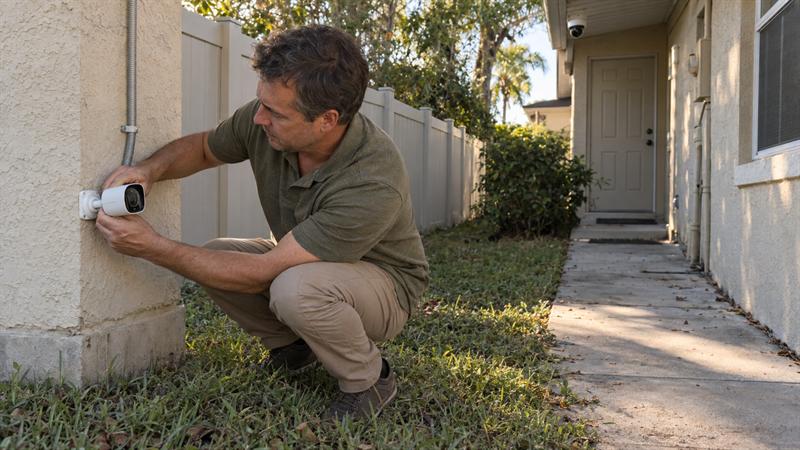
Why camera placement matters more than camera count
More cameras do not always fix weak coverage. In many homes, the real issue is placement. A camera that sees a wide area but misses the actual approach path may add little value.
That is where many setups fall short. Homeowners often add devices one by one, usually at the front door and backyard, while the side route between them stays open. The result is footage that shows where someone ended up, not how they got there.
Good camera planning works best when it fits into the larger home security system. For readers comparing cameras with alarms, sensors, and monitoring, home security system components explained gives helpful background.
Good coverage starts with likely approach paths
Start with the routes a person would most likely take to get close to the home. That includes walkways, driveway edges, side yards, fence gates, garage-side doors, and rear patio access.
A common mistake is covering the obvious entry while missing the path to it. When that happens, you lose the clearest view of movement before someone reaches the door or window.
The difference between deterrence and usable video
A visible camera can discourage someone from approaching, but that does not automatically make the footage useful. If the angle is wrong, the light is too harsh, or the camera is mounted too high, the recording may miss the details that matter.
This becomes more noticeable at night. Porch lights, headlights, and reflective surfaces can wash out the image, so the camera records motion without showing much detail.
Start with the highest-priority areas around the home
The best places to start are the areas someone is most likely to use to approach or enter the house. Do not divide cameras evenly just because the house has four sides. Prioritize the areas that create the most access and the most movement.
Front door and porch
The front door is often the top priority because it handles daily foot traffic, deliveries, visitors, and package drop-offs. A doorbell camera helps at close range, but it usually does not replace a wider front-entry view.
Many homeowners run into the same issue: the doorbell catches someone standing on the porch, but it may miss the walkway approach, the edge of the driveway, or another person who stayed just out of frame.
Main driveway and garage door
A driveway camera should do more than record parked cars. It should show how someone approaches the garage and whether they move beside the vehicles or angle toward a side garage entry.
A common mistake is aiming the camera too tightly at the garage door itself. That can leave out the service door, the side walk-up, or a person cutting across the edge of the driveway instead of using the center.
Back door, patio, and sliding doors
Rear access points need just as much attention because they often have less natural visibility. Many homes have a back patio or sliding door that sits outside the easiest line of sight from the street.
This is also where poor night coverage becomes more noticeable. A camera may show the patio clearly during the day, then lose useful detail after dark because the light source sits behind the subject or reflects off glass.
First-floor windows and side access points
Do not think of first-floor windows as isolated targets that each need their own camera. In many homes, it is more effective to cover the route someone would use to reach those windows.
Side yards, narrow walkways, fence lines, and gate access are some of the most overlooked parts of a residential layout. If exposed windows sit along a side path, the side approach usually needs attention first.
Best places to put outdoor security cameras
Outdoor cameras work best when they pick up movement before someone reaches the house. The strongest placements usually combine a clear angle, reasonable lighting, and a view that connects one coverage zone to the next.
Entry points people actually use
Focus on the doors and access routes used every day. That often means the front door, side door, garage entry, rear door, and patio entry.
What matters most is real use, not the formal layout. A side door used for daily entry may deserve better coverage than a rarely used area with little traffic.
Corners that cover long approach lines
Corner placements can work well because they show movement before someone reaches the entrance. They can also help bridge the gap between the front of the home and the side yard or backyard.
This is one of the clearest differences between broad visibility and useful coverage. A better angle can reduce transition gaps that leave someone out of view.
Gates, fences, and side yards
Side yards and gate lines are some of the most common blind spots around a home. They sit between the obvious camera zones, so they can be missed during basic planning.
That often becomes clear when footage is reviewed after a problem. The front and rear cameras may both work, but no camera clearly captures the movement between them. In many cases, that means the side access route was never truly covered.
Detached garages and sheds if applicable
Detached structures need their own planning because they create separate approach paths. If a detached garage, shed, or workshop holds vehicles, tools, or secondary entry access, the camera strategy should account for that.
In some layouts, a wider property view is enough. In others, distance and obstructions make that less effective, and a dedicated camera is the better fit.
Best places to put indoor security cameras
Indoor cameras work best when they confirm movement through the house after someone enters. They should support the exterior layout, not replace it.
At Cross Security, Inc., one issue with existing systems is relying too heavily on indoor coverage because the outdoor views were never planned well. That can leave the camera recording someone already inside instead of capturing the approach outside.
Main hallway or central traffic path
A hallway or central traffic path can be more useful than scattering cameras through separate rooms. If someone moves from an entry point into the home, that path usually gives a clearer view of direction and movement.
This works especially well in simpler layouts where several rooms feed into one common area. It creates a practical line of sight without trying to monitor every corner of the interior.
Entry-facing interior views
An indoor camera aimed toward an entry-facing area can help when the exterior view is obstructed by a deep porch, glare, or a difficult angle. It adds confirmation after entry, which is different from replacing exterior coverage.
This works best as part of a layered system. For homeowners comparing that approach with broader alarm and monitoring options, how security monitoring works for homes and businesses helps connect the pieces.
Common areas only, with privacy considerations
Indoor cameras belong in common areas, not in spaces where privacy expectations are higher. The goal is to follow movement through shared interior paths, not create unnecessary coverage inside the home.
Keeping indoor placement practical and limited can also make the system easier to use. When too many cameras cover low-value interior spaces, homeowners may stop checking them because the footage adds little.
Common home security camera blind spots homeowners miss
Blind spots are usually not dramatic empty spaces. They are the in-between zones that feel covered until you look at how someone actually moves through the property.
This is the part many homeowners underestimate. A house can have cameras at the front and back and still leave important transitions uncovered.
Areas hidden by rooflines, columns, landscaping, and parked vehicles
Roof overhangs, porch columns, tall shrubs, decorative trees, and parked vehicles all block visibility in ways that are easy to miss. A camera view can look fine on an app while still hiding the space closest to the wall, garage edge, or walkway.
This can create false confidence. The footage looks active, but movement near the structure disappears behind the obstruction.
Camera overlap gaps between front, side, and backyard coverage
The biggest coverage problems often happen between cameras, not directly under them. If one camera covers the front and another covers the back, the side path between them can stay partially or fully unseen.
This is where overlap matters. If movement appears in one view and then disappears before showing up in the next, the handoff between cameras is weak and the layout needs adjustment.
Nighttime visibility issues and light washout
Nighttime problems usually come from lighting, not just camera quality. Bright porch lights, reflective siding, headlights, and glass surfaces can wash out the image and flatten important detail.
This gets worse when cameras are installed based only on daytime visibility. A placement that looks strong at midday can become one of the weaker parts of the system after dark.
If your cameras are already installed but coverage still feels incomplete, the layout usually needs attention.
- Front and rear cameras work, but side access stays unclear
- Driveway footage shows cars, not the person walking up beside them
- Night recordings are bright, but details are washed out
- Doorbell footage starts too late to show the full approach
When those signs are present, repositioning or reworking the coverage plan is usually the next step.
Camera placement mistakes to avoid
Most placement mistakes do not come from buying the wrong camera first. They come from aiming cameras at the obvious object instead of the movement leading to it.
Mounting too high or too low
A camera mounted too high may lose useful detail. A camera mounted too low may catch a narrow slice of activity while missing the larger approach path.
The right height depends on what the camera needs to see. If the view gives you roofline and driveway but not the walk-up path, the position is working against the goal.
Pointing directly into bright light or reflective surfaces
Direct light creates washed-out footage and stronger shadows. Common sources include porch lights, street-facing glare, reflective windows, and vehicle headlights.
This is where night footage starts to break down. The camera still records, but the detail that explains what happened may drop off quickly.
Covering property without covering the approach path
A wide view of the yard is not the same as useful security coverage. If the camera sees open space but not the route a person takes to the side gate, garage door, or rear patio, the important part is still missing.
This can leave footage that feels active but answers very little. You can see the property, but not the movement that mattered.
Relying only on a doorbell camera
Doorbell cameras are useful, but they are limited. They work best as one piece of front-entry coverage, not as the full camera plan for the property.
A common pattern is relying on the doorbell for the whole front area, then realizing later that the driveway edge, side approach, or person standing off to the side never made it into view.
How many security cameras does a house need?
The right number depends on layout, entry points, detached structures, and blind spots. Most homeowners get better results by asking what needs to be covered first, then matching the camera count to the property.
Small homes and condos
Smaller homes and condos often need fewer cameras because there are fewer access routes. Even so, shared parking, common walkways, and limited exterior angles can change the plan.
In these layouts, one missed approach path usually matters more than total camera count. Tight spaces make placement precision more important.
Typical single-family homes
Most single-family homes need coverage for the front entry, rear access, garage area, and side approach routes. That creates the basic planning framework.
If one of those areas is missing, the system usually feels incomplete in practice. The home may have cameras, but the coverage still breaks at the points where movement matters most.
Larger homes, corner lots, and detached structures
Larger properties usually need more coverage because the distances are longer and the transitions are harder to see clearly. Corner lots, detached garages, and long side yards create extra approach lines that simpler homes do not have.
This is where adding cameras becomes more practical, but only after the coverage zones are mapped properly. More devices without a layout plan can repeat the same mistake.
When to adjust an existing camera system instead of adding more cameras
Many homes do not need a full camera replacement. They need a better layout. At Cross Security, Inc., that is a common pattern with existing systems that seem underpowered but are really just underplanned.
For homeowners keeping part or all of what they already have, monitoring an existing security system in Clearwater and Tampa Bay explains what to review, test, and activate as part of the bigger setup.
Signs the layout is the problem
If footage misses side approaches, loses detail in glare, or leaves long handoff gaps between cameras, the layout is usually the issue. The same is true when the driveway is clear but the walk-up path is not, or when the front door is covered but the side gate is not visible.
These problems usually do not improve by adding one more camera in a random spot. The next step is often re-aiming, repositioning, or rethinking how one zone connects to the next.
When existing-system support makes sense
If the cameras still work but the views are weak, support for the existing system can make sense. That is especially true when the problem comes from angle, overlap, or layout rather than hardware failure.
This matters because replacing everything is not always the most practical answer. Sometimes the biggest improvement comes from making the current system cover the right paths instead of recording the wrong ones.
Professional help vs. DIY placement
DIY placement works for simpler homes with straightforward entry points and clean lines of sight. Once the property has detached structures, longer side yards, awkward rooflines, or recurring blind spots, the planning gets harder and mistakes become more costly.
When basic DIY placement is enough
If the house has a simple footprint, limited entry points, and clear visibility around the perimeter, a basic DIY setup can work. The key is still to cover the approach lines, not just the doors themselves.
Even in simple homes, a common mistake is stopping too early. One or two cameras can create a false sense of completion when the side path or garage walk-up still sits outside the view.
When a custom coverage plan is worth it
A custom plan is worth it when the house has repeated blind spots, detached buildings, layered alarm needs, or an existing system that no longer fits the property well. This is especially true when multiple cameras already exist but the footage still leaves unanswered questions.
Homeowners sorting through provider options can use this local homeowner’s checklist for choosing a home security company to compare what actually matters before making changes.
Key Takeaways
- Start with entrances, garage access, rear doors, and the paths that lead to them.
- Do not ignore side yards, first-floor window approaches, and fence or gate access.
- Blind spots between cameras usually create bigger problems than having too few cameras overall.
- Doorbell cameras help, but they rarely cover the full front approach on their own.
- Existing systems often need better placement more than they need more equipment.
Conclusion
The real problem with home security camera placement is not always the number of cameras. Often, the important approach paths, transition zones, and night visibility issues were never handled correctly in the first place.
When that is overlooked, the system can keep recording activity without giving a clear picture of how someone moved around the property. That leads to a familiar frustration: cameras are installed, but the blind spots remain.
Cross Security, Inc. is a practical next step when you want coverage that matches how your home is laid out, especially if you already have cameras and the results still feel incomplete. When side access is unclear, garage approaches are weak, or the current system is not covering the right paths, a better layout may matter more than adding more devices.
Company approach
Cross Security, Inc. approaches residential camera planning by looking at how people move around a property, where the coverage breaks, and whether the current system is actually seeing the right things. That includes helping homeowners with new camera layouts and supporting existing systems that need better coverage rather than a full replacement.
This approach works well for homes that already have some equipment in place but still have weak spots around the garage, side yard, rear access, or front approach. Instead of defaulting to a one-size-fits-all package, the focus stays on what the home needs to cover and what the current layout is missing.
FAQ
Where should security cameras be placed on a house?
Security cameras should be placed where they can see the main ways someone approaches or enters the home. That usually includes the front door, driveway, garage access, back door, patio area, side-yard access points, and other first-floor entry routes.
The most useful placement is not always directly facing a door or window. In many homes, it works better to cover the path someone takes to reach that area. For example, a camera aimed only at a sliding door may miss the side gate and walkway that lead to it. That distinction often determines whether the footage explains movement or just shows where it ended.
How many security cameras does a typical home need?
A typical home needs enough cameras to cover its main entry points, likely approach paths, and the blind spots between them. There is no single number that fits every property because layout matters more than size alone.
A smaller home may need only a few well-placed cameras. A larger property, corner lot, or detached garage usually needs more because there are more transition zones to cover. What changes the decision most is how many separate ways someone can move around the exterior without being seen clearly.
Is a doorbell camera enough for home security?
No. A doorbell camera helps at the porch, but it usually does not cover the driveway edge, side approach, garage walk-up, or full front-yard movement.
A common misunderstanding is thinking the front door and the front of the property are the same thing. They are not. A doorbell camera may show someone at the door, but it often starts too late and too close to explain the full approach.
What are the most common blind spots for home security cameras?
The most common blind spots are side yards, fence gates, garage-side doors, hidden corners created by rooflines or columns, and the transition areas between front, side, and backyard coverage. Landscaping and parked vehicles also block visibility more than many homeowners expect.
The key point is that a home can look covered when each camera is viewed on its own and still have weak handoff between zones. If movement disappears between one camera and the next, the gap matters more than the individual views.
Should security cameras face windows or doors?
Security cameras should usually cover the approach to doors and vulnerable windows rather than only pointing straight at the surface itself. A direct view can help, but it often misses how someone got there.
For example, a side window on the first floor may be better covered by a camera watching the narrow walkway that leads to it than by a tight shot of the glass alone. What matters most is seeing movement before the person reaches the entry point.
Can existing security cameras be repositioned instead of replaced?
Yes. Existing cameras can often be repositioned instead of replaced when the main problem is layout rather than hardware. If footage misses side approaches, gets washed out at night, or leaves gaps between front and rear coverage, the system usually needs a better angle or better zone connection first.
This is a common issue with existing camera setups. A camera can record the driveway clearly and still fail to cover the person walking up beside the garage. In that situation, the real problem is placement, not camera count.
Recent Comments